

The New York Times’ Familiar AIPAC Playbook
When American political participation involves support for Israel, The New York Times treats ordinary advocacy as evidence of foreign manipulation.

The New York Times devoted this week’s episode of their podcast, The Daily, to a familiar premise: AIPAC is too powerful, too wealthy and too influential in American politics. Except the evidence doesn’t support that grandiose claim that’s been so gleefully parroted around media and social media for the last few years. If the New York Times had any journalistic integrity, they would be honest about that. Instead, what we heard was an entire episode dedicated to defaming AIPAC and portraying the group as a dark money sinister force to undermine American voters.
For some reason when the subject is AIPAC, the story almost always begins with the assumption that there is something uniquely suspect about American citizens advocating for a strong U.S.-Israel partnership.
The New York Times has, in my view, spent years abandoning any pretense of even-handed coverage when it comes to Israel. That bias has become especially pronounced since October 7, with a steady stream of reporting that omits context, amplifies dubious claims and rushes to sensational allegations before they could be verified.
One of the clearest examples came last year, when the paper published allegations that Israeli military dogs had “raped” Palestinian detainees. This was published despite the fact that it isn’t biologically possible to train a dog to have sexual arousal on command. Sadly, such absurdities have become commonplace at the New York Times. From repeated reliance on Hamas sources without disclosure, to corrections that receive a fraction of the attention of the original claims, the paper has very much earned their reputation for treating Israel differently than any other state at war. In that context, this week’s episode wasn’t surprising in the slightest.
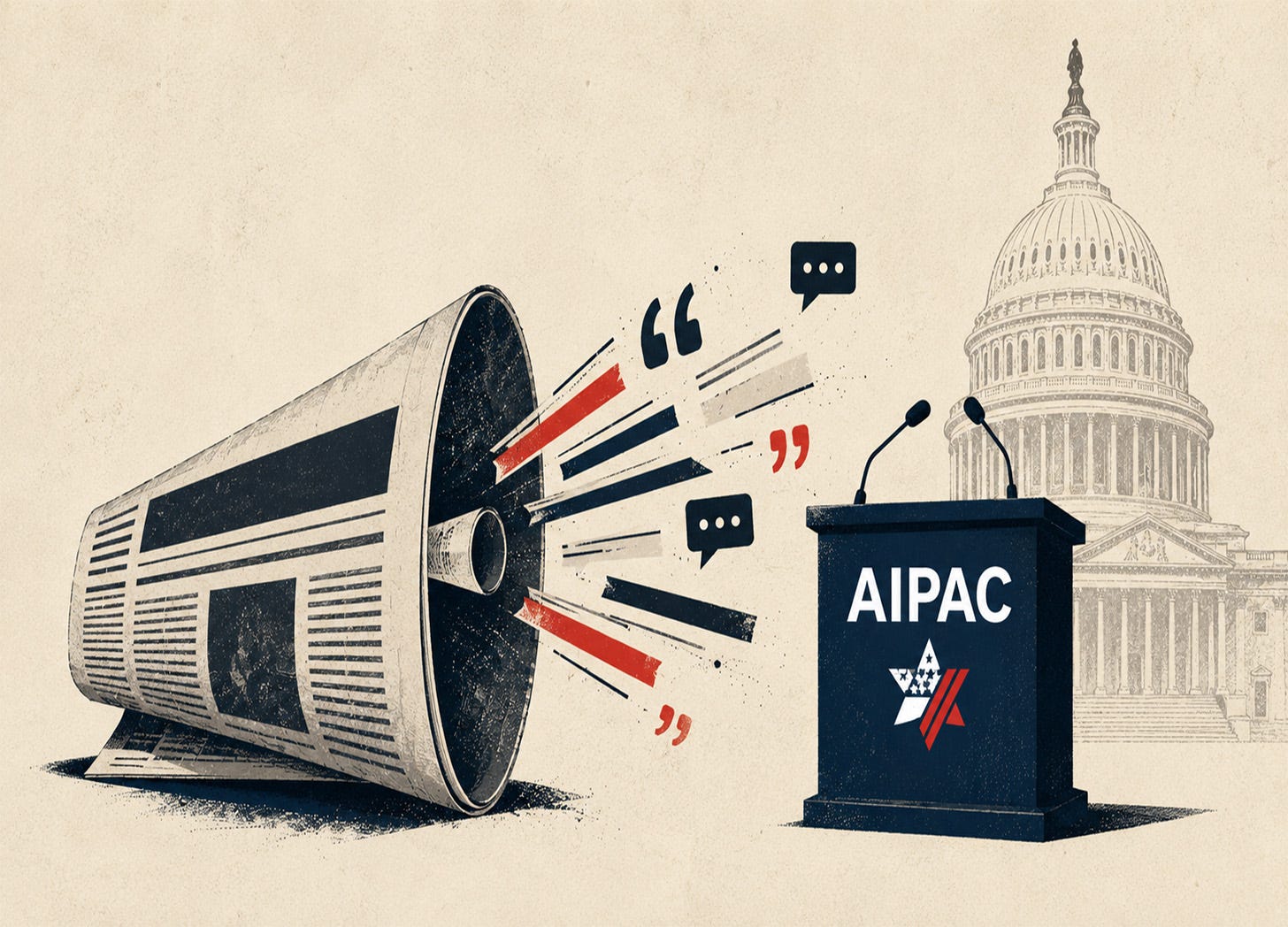
That said, the facts are that AIPAC is an American (exclusively) organization. It is governed by Americans, funded exclusively by Americans, and advocates for what its members believe advances American interests through a strong U.S.-Israel alliance. It does not represent the Israeli government, determine Israeli policy or make military decisions. Under U.S. law, foreign nationals cannot contribute to federal campaigns or direct the activities of political committees. Yet coverage of AIPAC has frequently defamed the organization incorrectly claiming that it functions as a foreign arm of the Israeli government rather than an American advocacy organization exercising the same constitutional rights as countless other interest groups.
Increasingly, AIPAC has become a lightning rod for anger that has very little to do with AIPAC itself. For many activists and much of the media, the organization has become shorthand for every grievance they have with Israel. But AIPAC isn’t Israel. It doesn’t represent the Israeli government or write Israeli policy. It represents Americans advocating for a strong U.S.-Israel relationship. Blaming AIPAC for decisions made by a sovereign foreign government is irrational and only done when the accuser has inherent biases against the American Jewish community — whether the accuser realizes it or not.
In the aftermath of the episode, AIPAC reported that The New York Times never even contacted the organization before airing the episode to verify its claims or give it an opportunity to respond. Instead, AIPAC says it first saw the allegations after publication, to which they issued a point-by-point rebuttal.
Among other things, the podcast suggested AIPAC is no longer bipartisan — an absurd characterization given AIPAC openly supports Democrats and Republicans who back the U.S.-Israel alliance and has also worked to defeat Republican candidates it viewed as hostile to that relationship, including Thomas Massie this election cycle and Bob Good previously. Oddly enough, none of that made it into the New York Times’ episode.
The podcast also suggested AIPAC put Israel’s interests ahead of America’s when it opposed the 2015 Iran nuclear deal. But the truth is the opposite. AIPAC opposed the JCPOA because it believed the agreement threatened American national security, a position shared by members of both parties in Congress — and one they were correct on.
The most troubling claim, however, was the suggestion that AIPAC’s political activity has somehow fueled antisemitism by encouraging rhetoric about “Jewish influence.” That’s victim blaming. Antisemitism exists because antisemites hate Jews, not because Jewish Americans exercise the same political rights as everyone else. The fact the New York Times doesn’t see this is indicative of their own shameful bias.
But surely where there is smoke there is fire, right? Not exactly. If we look at the actual numbers, we have a larger picture of what AIPAC’s “disproportionate” influence really is. To start, AIPAC spent roughly $3.8 million on federal lobbying in 2025. The U.S. Chamber of Commerce spent about $72 million. The National Association of Realtors spent roughly $55 million. Big pharma spent tens of millions more. In total, lobbying expenditures in Washington exceeded $5 billion. AIPAC represents only a tiny fraction of that spending, yet a massively disproportionate amount of chatter in the media.
The trends are similar for campaign spending. It’s true that AIPAC affiliated PACs have spent tens of millions of dollars this election cycle... which sounds like a lot until you compare it with the rest of American politics. Labor unions spend heavily. So do environmental groups, trial lawyers, Planned Parenthood, the NRA, pharmaceutical companies and, increasingly, the technology sector. None of those organizations are routinely portrayed as evidence that America is being manipulated by a hidden constituency. AIPAC is, despite being funded exclusively by Americans.
So why is AIPAC is so often treated as though its participation in American politics is fundamentally different from everyone else’s?
The Daily intentionally portrayed ordinary political participation by American Jews and supporters as something suspicious simply because the Americans participating happen to support Israel. There’s a word for that kind of bias.
The real story here isn’t that AIPAC spends money in politics, as every major advocacy organization in America does. The real story is that as a result of a coordinated subversion campaign to demoralize the West, Israel has become so contentious that even ordinary American political participation is portrayed as evidence of something sinister and scheming by the Jews.
Tragically for the New York Times, this week’s episode wasn’t an outlier. It was a chapter in a long pattern. Instead of treating AIPAC like any other major American lobbying organization, The New York Times once again portrayed support for Israel as uniquely nefarious.
The implication is subtle but unmistakable: when millions of Americans organize to support environmental causes, gun rights, abortion rights or organized labor, it’s democracy. When millions of Americans organize to support the mutually beneficial U.S.-Israel partnership, it’s treated as a foreign influence operation undermining America’s best interest.